01 – THE BUSINESS CASE
The Integration Tax Is Real – and It Is Compounding
Every new service, every new partner, every convergent bundle triggers the same cycle: API mapping, integration testing, regression validation, deployment. TMF Open APIs have improved matters by establishing common semantics across platforms – yet the volume of integration work required has not gone away. Each new partner relationship still demands a project. That is the Integration Tax, and it compounds with every new service category an operator wants to enter.
The commercial consequences are direct. An operator seeking to launch exclusive streaming bundles for the FIFA World Cup 2026 must rapidly onboard a broadcaster, configure entitlements, and synchronise billing – all within weeks. With today’s rigid architectures, that window closes before the first integration test is written. The same constraint applies to smart home bundles, connected health services, IoT partnerships, and every beyond-connectivity offering an operator wants to bring to market.
The biggest barrier to telco service innovation is not technology. It is the time it takes to connect systems.
| 6–12 monthsTypical TTM for a new partner-integrated service | ~40%Engineering cycles consumed by integration maintenance | ZeroManual handoffs in Knot’s agentic demo flow, end-to-end |
02 – WHAT KNOT SOLUTIONS BUILT
The Engagement Agent and BSS Master Orchestrator
TM Forum Catalyst C26.0.940 demonstrates a working Agentic Integration Layer – using a Smart Home package as the demonstration vehicle, with the architecture designed to span both connectivity and beyond-connectivity service domains. Knot Solutions architects the customer-facing intelligence layer of this stack, developing and operating both the Engagement Agent and BSS Master Orchestrator – the twin engines that translate customer intent into precise, executable business outcomes across product catalogue, charging, and order management.
The Engagement Agent interprets intent, gathers the necessary inputs, and routes it to the BSS Master Orchestrator. The BSS Master Orchestrator receives that resolved intent via MCP, reasons over it using DAG-based workflow templates, and dispatches to the appropriate downstream agent – BSS, OSS, network, or third-party – based on what the request actually requires. From a single interface, a single customer conversation, the right system gets the right instruction.
This is not automation layered on top of static integration. It is semantic cognition – agents that understand intent, resolve ambiguity, and act without human intervention, across the full breadth of a CSP’s operational ecosystem.
Key Capabilities
- Semantic Intent Understanding: The Engagement Agent understands natural language in any language – not keywords, intent. It asks targeted business questions to fill gaps, then routes with precision.
- Intelligent BSS / OSS Routing: The same unified interface routes to BSS for catalogue, charging, and orders – or OSS for provisioning – based on what the request actually requires. No configuration per request type.
- Personalised Recommendations: The BSS Master Orchestrator reads customer profile and usage history to surface relevant services before the customer asks.
- Partner-Ready Extensibility: Third-party agents – IoT, content, digital health, fintech – are first-class citizens. New partners onboard without custom integration development.
03 – TECHNICAL ARCHITECTURE
Intent-Driven. Agent-Orchestrated. TM Forum ODA Compliant.
The architecture separates two concerns that traditional BSS systems conflate: understanding what is wanted and deciding what to do about it. The Engagement Agent handles the former; the BSS Master Orchestrator the latter. Both run their own LLM for intent parsing and a Vector Database for knowledge retrieval. They communicate via MCP – preserving full context across the handoff.
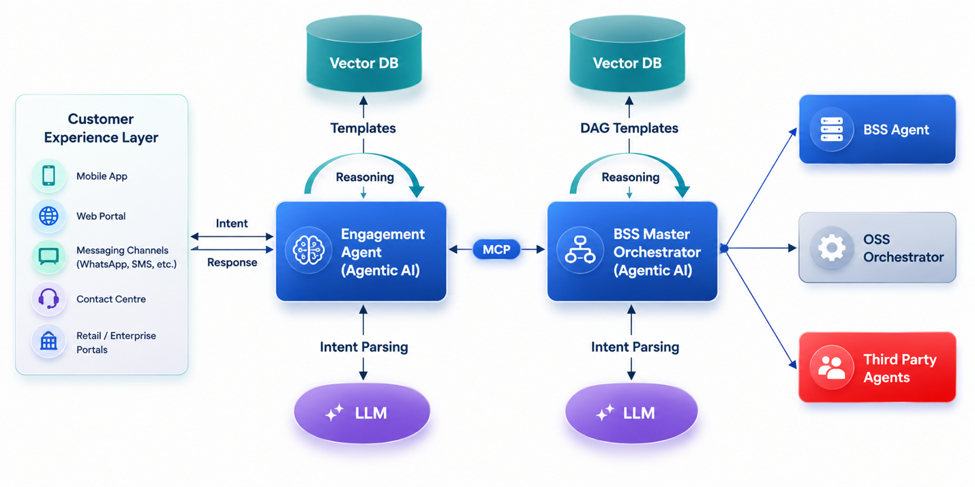
Figure 1 – Knot Solutions Agentic AI Architecture
How It Works – In Five Steps
1. Customer expresses intent. Natural language, any language, any level of specificity. No structured input required.
2. Engagement Agent interprets and fills gaps. LLM parses intent against contextual templates, identifies what is ambiguous, asks targeted business questions to complete the picture.
3. MCP handoff to BSS Master Orchestrator. Resolved intent and full context pass via MCP – preserving the customer interaction state for downstream reasoning.
4. Orchestrator routes to the right agent. DAG templates and LLM reasoning select the downstream target: BSS Agent for product and charging operations; OSS Orchestrator for provisioning; Network Agents for connectivity-layer configuration; Beyond-Telco Agents for third-party VAS.
5. Execution confirmed, response returned. The Engagement Agent presents confirmation to the customer in natural language. Intent to execution – in minutes.
04 – WHAT THIS MEANS FOR CSPS
No More Hard-Coded Integrations
The shift from static API integration to intent-driven agent orchestration changes the economics of service delivery and partner onboarding. New partner categories – smart energy, connected health, edge compute, automotive services – arrive as agent-addressable endpoints rather than integration projects. The operator’s ability to participate in converged service ecosystems expands without a corresponding expansion in engineering overhead.
| Dimension | Traditional Integration | Agentic Architecture |
| Service launch | 6–12 months of API mapping, integration testing, validation | ✓Intent expressed, agents route – days not months |
| Partner onboarding | Custom integration project per partner, regardless of standards | ✓New partners are first-class agent endpoints – no bespoke build |
| Beyond-connectivity VAS | Each VAS category is a separate integration scope | ✓IoT, health, content, fintech agents operate on the same framework |
| Customer experience | Structured catalogue navigation, form-based self-service | ✓Natural language, any language, proactive personalised recommendations |
| Network interaction | Separate OSS workflow; manual business-to-network translation | ✓Network Agents operate in the same orchestration plane as BSS |
05 – RAPTR AI & RAPTRDXP
Intelligence and BSS, Built as One
The agentic architecture demonstrated in this Catalyst is a live expression of how Knot Solutions builds – AI and BSS designed together, not bolted together. Raptr AI is Knot’s AI intelligence layer for the telecom operational environment, spanning CVM intelligence, operations intelligence, and the Agentic AI and Workflow Coordination capability demonstrated here. RaptrDXP is the cloud-native, AI native, microservices-based BSS stack – fully composable, ODA-aligned, and built for the 5G and IoT service landscape. Together, they give CSPs intent-driven customer engagement, intelligent operations, and a BSS that adapts to the business rather than constraining it.
Both platforms operate independently – Raptr AI provides services to RaptrDXP BSS. At the same time, it can integrate with any existing BSS/OSS stack without requiring platform replacement. But their full value is realized when they work together : a BSS that understands what customers mean, and acts on it.
Explore Raptr AI and RaptrDXP BSS: knotsolutions.com/products
06 – ABOUT KNOT SOLUTIONS
| Knot Solutions® since 2006, has been delivering large-scale digital transformation solutions that has helped major CSP to increase revenue streams at lower costs and better efficiencies through a combination of consulting, products, solutions, and services. |
| See It Live at DTW Ignite · Copenhagen · 23–25 June 2026→ Request a Demo | knotsolutions.com/contact-us |