MVNOs win by moving fast. Plans change. Partners change. Customer expectations change. If your BSS stack is heavy, you spend months building basics instead of shipping offers.
Cloud SaaS BSS flips that. You start with a ready base, configure what you need, connect to your MVNE/MNO, and go live sooner with lower ongoing spend.
Knot Solutions positions RaptrDXP™ in this category: a cloud SaaS BSS built on microservices, designed for quick deployment cycles and ready modules for MVNOs and CSPs.
What drives high TCO in a classic MVNO BSS setup
TCO usually climbs because of:
- Large upfront infra spend: environments for dev, test, staging, production, plus security and monitoring.
- Long build work: catalog, charging rules, invoices, taxes, payments, care flows.
- Integration drag: provisioning, SIM/eSIM life cycle, KYC, payment gateways, messaging, reporting.
- Upgrades and patching: every change turns into a mini project.
- Custom code debt: changes get slower and more expensive over time.
How cloud SaaS BSS reduces TCO for MVNOs
- Predictable costs instead of heavy upfront spend
Cloud BSS shifts cost from big upfront infra to a steadier operating cost model. Knot Solutions also describes cloud BSS as swapping upfront infrastructure spend for more predictable operating expense.
- Built to scale without overbuying
A microservices setup lets you scale the parts that need it (charging, billing runs, order bursts) without scaling everything. TM Forum’s ODA directory lists RaptrDXP as a cloud-native SaaS BSS built on microservices.
- Multi-tenant SaaS reduces per-operator cost
Multi-tenant SaaS spreads base platform operations across tenants while keeping each operator separated by tenant controls. Knot Solutions describes RaptrDXP as a multi-tenant SaaS option for private and public cloud. (Knot Solutions)
- Ready BSS modules cut build and support work
The fastest way to reduce TCO is to avoid building common blocks from scratch. Knot Solutions lists out-of-the-box capabilities such as:
- omni-channel engagement
- customer and partner management
- service activation
- real-time rating and charging
- billing, revenue, and order management (Knot Solutions)
Less custom code usually means lower support cost, fewer regressions, and easier upgrades.
How cloud SaaS BSS speeds deployment for MVNOs

You configure a working base instead of building one
With SaaS BSS, the base stack exists already. Your timeline shifts to:
- configure catalog and offers
- set charging and billing rules
- connect provisioning and identity checks
- test end-to-end flows
TM Forum also calls out “quick deployment cycles” for microservices-based SaaS BSS in this category.
APIs shorten integration time with MVNE/MNO stacks
MVNO launch dates usually slip due to integration. A strong API approach reduces back-and-forth and lowers rework when partners change. Knot Solutions’ brochure describes an open API approach to support scale and agility and to add solutions quickly.
Faster product launches after go-live
Speed is not only about the launch date. It’s also about how fast you can ship:
- new packs and add-ons
- bundles and promos
- partner-led offers
Real-time charging plus a configurable catalog is what makes this possible in day-to-day operations.
Where MVNOs see the biggest cost + speed wins
1) Offer setup and changes
When pricing and rules are configuration-led, you can iterate faster and spend less on release cycles.
2) Order-to-cash stability
Reducing manual steps across order capture, activation, charging, invoicing, and collections lowers ops load and reduces leakage risk. Knot Solutions highlights real-time rating/charging and billing modules as core parts of the stack.
3) Partner and dealer operations
Partner management plus order management helps with onboarding and ongoing partner operations.
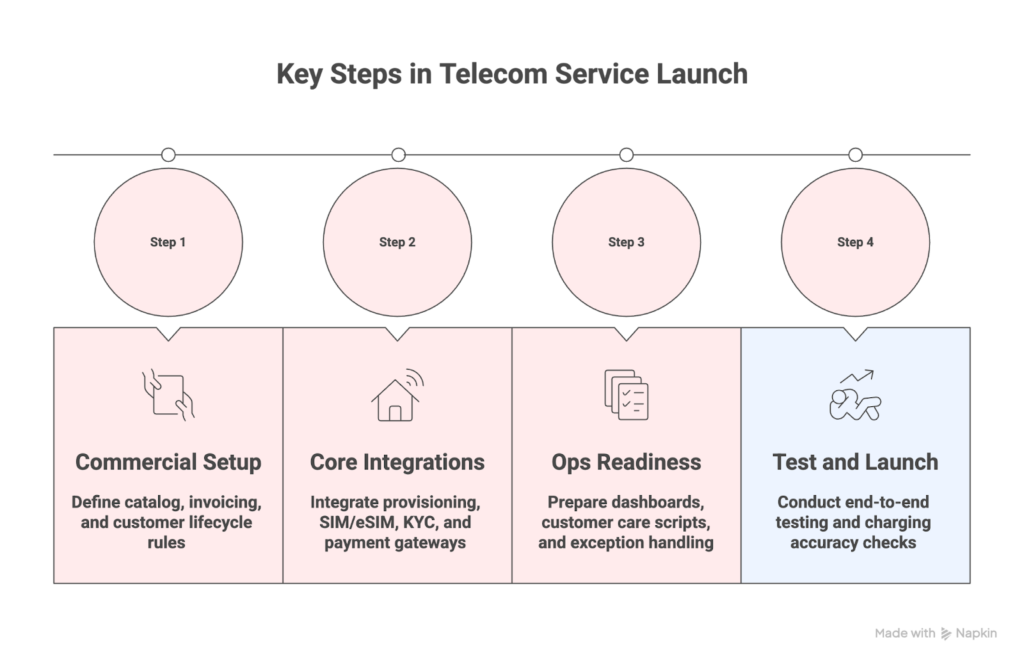
Practical rollout plan for an MVNO using SaaS BSS
Microservices-based SaaS setups are built for quicker deployment cycles, which helps keep this plan realistic.
What to check when choosing a cloud SaaS BSS for your MVNO
- Charging depth: real-time rating, policy control, reversals, accuracy under load
- Catalog flexibility: bundles, shared plans, enterprise pricing, promo rules
- Integration readiness: API coverage, events/webhooks, sandbox access (if provided)
- Tenant model: multi-tenant support, isolation, roles, audit logs
- Core module coverage: activation, billing, revenue, orders, partner ops
Conclusion
Cloud SaaS BSS helps MVNOs cut total cost by reducing infrastructure spend, limiting custom development, and lowering ongoing support and upgrade effort. It also speeds deployment because you start with ready BSS modules and connect through APIs instead of building core systems from zero. Knot Solutions’ RaptrDXP™ exemplifies this, being a cloud SaaS BSS built on microservices and designed for quick deployment cycles with ready modules for MVNOs and CSPs. For MVNOs, that means faster go-live, quicker plan changes after launch, and more time spent on growth instead of platform maintenance.—